

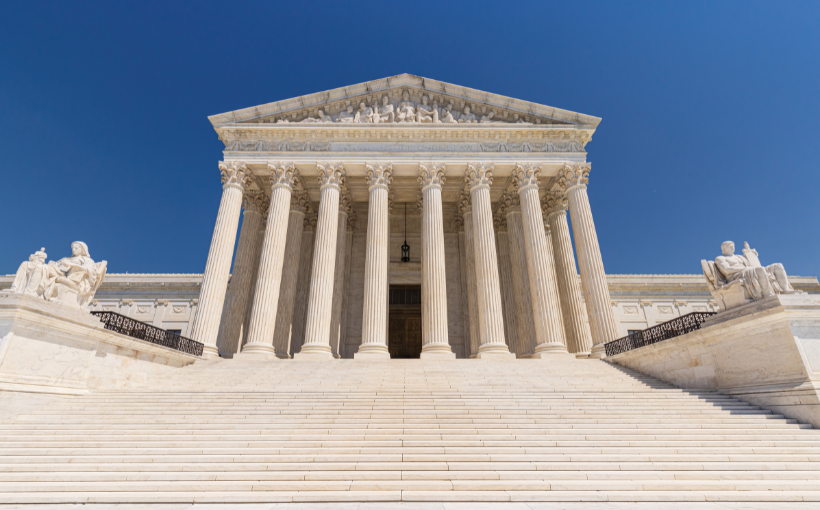
The Supreme Court has struck down President Trump’s tariffs. In a 170-page decision and a 6-3 vote, the court ruled that Trump’s use of the 1977 International Emergency Economic Powers Act (IEEPA) was not lawful.
The case addressed whether the executive could leverage IEEPA’s emergency authority to set broad, economy-wide tariff duties in response to threats like trade deficits and cross-border drug trafficking.
Chief Justice Roberts, writing for a majority that included Justices Sotomayor, Kagan, Jackson, Gorsuch and Barrett, emphasized that Article I of the Constitution gives “Congress alone … the power to lay and collect Taxes, Duties, Imposts and Excises.”
The Court found that while IEEPA authorizes the President to “regulate … importation or exportation,” that term does not include the extraordinary power to impose tariffs. As a result, the Court affirmed lower-court rulings blocking the challenged measures, concluding that the administration’s emergency-based tariff framework exceeded the limits of the statute.
Justice Thomas, joined by Justices Kavanaugh and Alito, dissented in part. The opinion marks a major curtailment of executive trade authority and reinforces that sweeping tariff power resides with Congress.
“With the U.S. Supreme Court ruling that tariffs imposed under the International Emergency Economic Powers Act (IEEPA) exceed presidential authority, the decision restores a measure of predictability to U.S. trade policy—easing pressure on supply chains and reducing costs for businesses,” Mark Rose, Chair and CEO, Avison Young, told Connect Money.
“For commercial real estate, this may temper some of the urgency surrounding reshoring initiatives, but it simultaneously supports broader economic stability, which strengthens demand across industrial, retail, and office sectors.”
The post Supreme Court Rules President Cannot Use IEEPA to Impose Tariffs appeared first on Connect Money.
